Русский
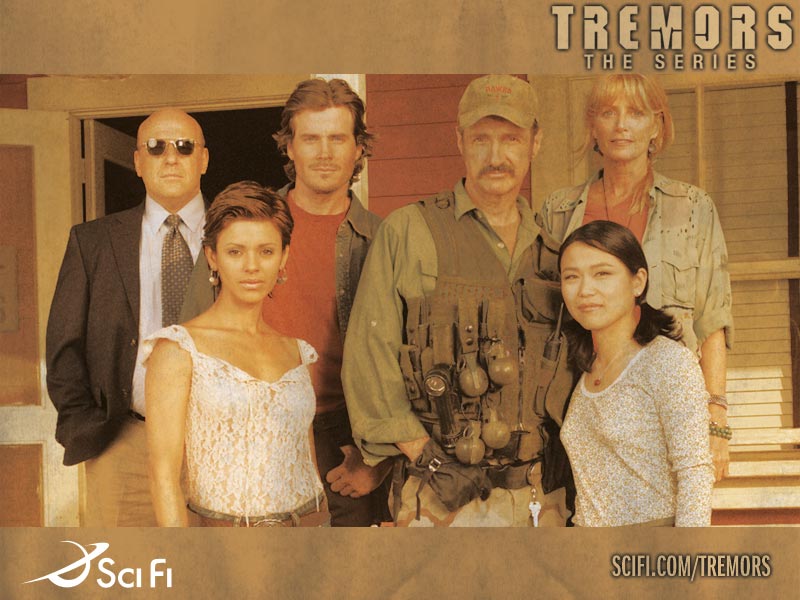

Tremors: The Series Cast and Crew Q&A at TremorsFest 2024
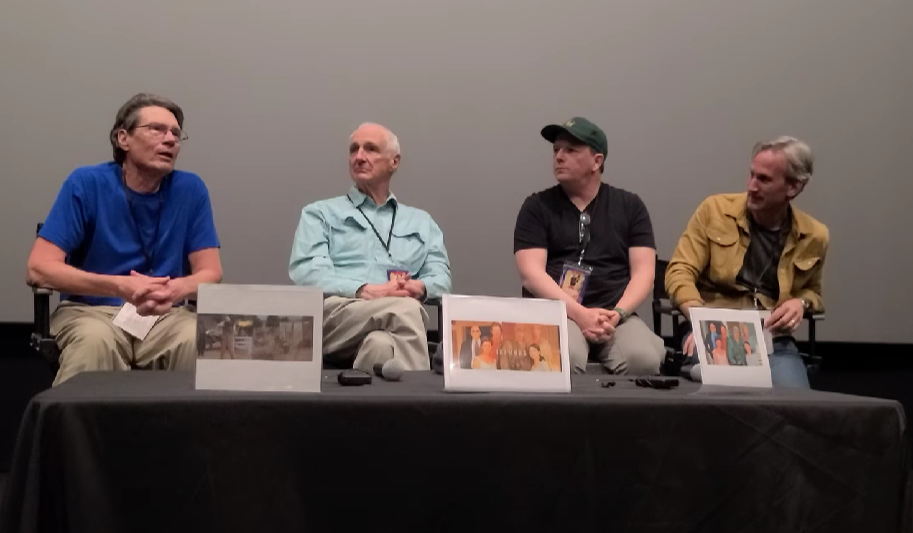
The following Q&A session took place at the October 2024 TremorsFest held in Santa Fe, NM immideattely after a screening of two episodes of Tremors: The Series. One of them was Shriek and Destroy, the other one is unclear.
The Q&A featured the following cast and crew members (on photo from left to right, except for Glenn Maddock):
- S.S. Wilson - founding member of Stampede Entertainment, the writer of Tremors 1, 2, 3, 4 and the series, the director of Tremors 4.
- Michael Gross - actor starring as Burt Gummer in all of the movies and the series.
- J.D. Walsh - actor starring as Larry Norvel in Tremors: The Series.
- Christopher Silber - staff writer on Tremors: The Series.
- Glenn Maddock - event host, organizer, brother of Brent Maddock, the co-founder of Stampede Entertainment and writer of Tremors 1, 2, 3, 4 and the series.
You can also watch this Q&A session on YouTube.
Michael Gross: Did you write either of those episodes?
Christopher Silber: I did not.
Michael Gross: Yeah. Just curious.
Glenn Maddock: Steve wrote them both with my brother [Brent Maddock].
Michael Gross: Oh, is that the case?
S.S. Wilson: And John Schulian.
Glenn: Between Steve and Chris, most episodes were written, and there were a few other writers, but most episodes were written by them.
S.S. Wilson: Several other writers. We had a real writing group.
J.D. Walsh: How many writers? Like, twelve? Eight?
S.S. Wilson: No, I think it was five.
Michael Gross: I don't mean to put anybody on the spot, but I'm gonna put somebody on the spot. Steve, what did you think about it after all these years? Just looking back on it.
S.S. Wilson: I have a positive thing to say. Making this show was not easy for us and it got worse until we got fired. That was kinda the worst part. And so I always kind of had a bad feeling about the show. And the second thing I wanna say, and I really hope that all these people talk more about it, is that on Tremors 1, 2, 3 and 4, all of us, I mean all of us at Stampede, were on set every day, doing stuff, overseeing, nitpicking, bothering Ron, and on the show, the show shot down in Mexico with the assistance of SciFi, it was going to shoot in New Mexico, but they refused to do that, and, you know, everybody said to us: "You guys are executive producers! You have to be in Los Angeles writing scripts, don't bother us!" So, we were not on set, other than to visit it a couple of times, and a different director came in for almost every episode and did not necessarily shoot the thing the way we thought they should be shot, so I ended up with this negative feeling. I've been rewatching the show in preparation for coming here for this event, and I have to say — it's not that bad! It's pretty good, and that's been a very pleasing thing to see, especially the characters we began to develop, the relationship between Michael and Victor Browne [starring as Tyler Reed], the characters, and all of that stuff began to improve, and we were building, building, building toward what we hoped would be our next season. So, I left the show then to do Tremors 4, because Universal refused to wait three weeks. They pulled Michael out of the show, which is why he's not in some episodes, and they made me leave the show, so we could start Tremors 4 three weeks earlier. Could've finished this up, but we didn't. So, all those things added up to where we are now. So I'm really hoping here from Chris, from J.D and from Michael about the stories on the set, I hope that's the question you have. It was a crazy world down there in Mexico.
Michael Gross: I'm just gonna add one thing, and that was… I don't know how you all feel, but having worked with him [S.S. Wilson] on Tremors 1, 2 and 3, I found it very disheartening not to have him on the set. There were several different directors, all of whom were wonderful people, but, I mean, to me Steve and Brent and people like Ron were the heart of this piece. And I had forgotten until I watched this that I had a producer credit on this show, and the only damn reason I had a producer credit is because they needed a liaison there, between [Steve] and… you know, because I was the only one with the original bunch who was down there. And I just told a friend of mine with whom I was sitting, I didn't want to be a producer, I just wanted to hit my marks, say my lines and not bump into the furniture and be an actor, because I'm lazy, and I didn't want to be a producer but it was forced upon me because they [Stampede] were not down there and I hated being away from them! To me, they were the soul of this piece!
S.S. Wilson: Michael knew the show better than anyone else down there, everybody else was learning.
Michael Gross: But still, I was no substitute for them and their institutional knowledge and what they wanted and the way they handled things. With 1, 2, 3 and 4 [the approach to filmmaking was] very much "let's talk about it."
S.S. Wilson: It was always collaborative.
Michael Gross: Let's all sort it out, very collaborative, and we couldn't quite have that at that distance, otherwise I would've been on the phone with him all the time. Every time we do a shot, I wanted to talk with them. I couldn't handle it by myself and I think I was a miserable failure as a producer.
S.S. Wilson: Chris, talk a little bit maybe about the writers room. Because we broke stories the way they traditionally do in television: you've got your five or six writers together and everybody gets in a room and you go: "Well, this could happen! Rosalita could do this or Larry could do that!", and some stories work their way to the surface and we work on them, but could you speak about that?
Christopher Silbert: Sure! I mean, this was my first job in television at all, so I came on as a rosy-cheeked staff writer and I had never been on the show before, so it was so exciting. And you know, we weren't in Mexico, we were on Universal lot, which was amazing, so cool. My friend and I were both staff writers and there were some people who had worked on shows that we'd grown up with, which was amazing, and we had Brent and Steve, and this was their baby, right? So, from my perspective, I'm sitting here and learning from all these people and trying very hard to do what someone on the writing staff needs to do, which is try to honor the material, right? We had that traditional, we sat at the table, I had asked someone exactly what we were supposed to do, how it works, how do you come up with stories, how do you figure out what's gonna happen? But also trying to catch up and learn what the tone should be. And the tone, I think, is very special but very specific, 'cause it's not camp. It's not camp. There's humor obviously involved, and real scares, and so that was part of the learning curve, as well as everything else. And it's been so long, so do I remember the specifics? I remember some hard weekends doing rewrites, I remember writing while we were shooting a couple times at least. And being able to work with Steve and with Brent, which was really special, I think we co-wrote a couple together.
S.S. Wilson: I'm sure we did, yes.
Christopher Silbert: And that was fun, and every show I've worked on since I was lucky enough to be on set, to produce. As an executive producer and showrunner now, that's the feeling and that's something that we didn't get. And even more than that, we shot everything, and then we weren't airing right away, we were airing in a while, so we all left. And then everything was finished up without the writers and we aired months later, I don't know if you remember that.
S.S. Wilson: Well, I do remember that oddly enough, famously, the show was shown out of sequence, you probably all know that, and oddly enough again, you voted… Where did Glenn go? You did a vote for these episodes, right?
Glenn Maddock: Yeah, we did an online poll and it wasn't even close.
S.S. Wilson: So, you all chose the episode that SciFi network hated the most.
Glenn Maddock: They didn't get it.
S.S. Wilson: It was Shriek and Destroy, and it was our second episode and it was supposed to lead us into the other episodes, and they hated it so much they said: "We're just gonna show Ghost Dance next." We said: "Ghost Dance introduces a whole new set of concepts. We don't wanna do that!" They said: "Too bad, that's what we're doing." And it's funny to see it now, because I watched it for the first time in several years… I thought "What did they hate about it? I don't get it." So, anyway…
J.D. Walsh: They wanted to get to Larry. Get us to Larry! Even though he's at the end, [unintelligible].
S.S. Wilson: So yeah, talk about your arrival to the show…
J.D. Walsh: Yeah, I had an audition just after New Year's, and got really sick, and it was, like, a perfect part for me: a guy who is, like, annoying, and he's from Wisconsin. I'm from Wisconsin. And I was like, oh, that's perfect, and I got too sick, I think it's the only time in 25 years. And I was, like, oh, I guess I can't go. They didn't find the person and I auditioned a week later and then all of a sudden I was in Border Town, Mexico a week later and it was great. You [Michael Gross] was there for the first episode I was there, I was super excited to work with Michael, it was the best. I remember asking you if, when you're the lead of the show, if you want more lines or if you want less lines. Because as an actor, you theoretically count your lines. But if you're the lead of the show, you're like: "Argh, I gotta memorize all these lines." Especially if it's, like, scientific stuff or guns and such. And we went down there… the infrastructure was shaky at best, whether it be where we were staying, you would just go to use the faucet and today there was no water, and they would just go [shrugs] "No water today." So that was challenging, 'cause I use water daily, and then shooting… I was super excited, except for, I had these long monologues, and I don't know if it was intentional, but on my first day I had to do three scenes back to back to back that were all my scenes, almost as if it was a test of "I don't know, is this guy gonna be able to do this?" So I spent until, like, five in the morning memorizing the lines, so if you watch my first episode I had memorized every scene, every line, and I had just these giant monologues of a fast talker, yeah, it's the worst. But then they asked me to, this is a true story, they asked me to be a regular. I'd never been a regular before. I'm not joking, this is not an exaggeration. My agent said: "That's great. Chuck Lorre has a new pilot and he wants you to read a part. He thinks you're perfect for the brother Alan", and I was like, okay. And then I went and I read the script, it was fine, it was a sitcom, but there was money on the table with Tremors. And so it was sort of a no brainer: you've got a chance, a good chance, 'cause they wrote it for you, to be in this sitcom, or you could get guaranteed money, and so I took guaranteed money. It was Two and a Half Men, which went for half a season and was unfortunately cancelled. 'Cause they showed them out of order. You guys have any questions?
Q: Is it true that if the series had continued that Val and Earl were supposed to come back?
S.S. Wilson: That was never planned, because back that far Kevin was still kinda negative about Tremors so it was not something we would've counted on. Yeah, there's a lot of rumors out there, but that one, I don't think it's true.
Q: What was the reason for the recast of the two actors?
S.S. Wilson: You mean Nancy and Jodi? Well, sad story for both. Susan Chuang, we asked her from Tremors 3. She played Jodi in Tremors 3, we said: "Please, come to Mexico! We're doing a series!" She said: "I don't wanna go to Mexico! Doesn't sound good to me." And we said, okay. Luckily, we found Lela Lee. The strangest story is that Charlotte Stewart was perfectly fine, happy to come back and be Nancy, she had just done a cancer commercial, because she is, in real life, a cancer survivor. Because of the contract she signed with the people, whatever she was advertising for them, she was not supposed to do any other television for the run of that commercial, and we begged them to let her out of it and they said "no, not letting her out."
Michael Gross: I love Charlotte Stewart. We loved her. And, I mean, Marcia Strassman was wonderful and became a good friend.
S.S. Wilson: But yeah, they wouldn't let her out of it. We had some bad luck on the show.
Q: When you guys brought on Christopher Lloyd, was it obvious that you guys would try to bring in that time travel joke that you said to him at the end?
J.D. Walsh: I was all-in for Christopher Lloyd being here. I was so excited. At one point in one of the scenes we blow up something and we're all supposed to celebrate and behind me he's celebrating going "WOAHHHH!" And I was like: "Holy moly, that is Dr. Brown behind me", it sounded exactly like him. Also, you have to put your cameras down for this part. We sat in the car for a long time, so he told me a lot of stories. He's like: "Where are you from?" "Madison, Wisconsin." "Oh! I dated a nurse up there. During Denis the Menace I would drive up every weekend." "Cool!" Okay, put the cameras back up.
Christopher Silber: I just wanna say, that is something that was amazing about this show because we're down in Mexico, we [unintelligible], but the casting is, not just because I'm sitting next to two of the series' regulars, but the guest casting was incredible. There was no one we couldn't try and oftentimes get. I mean, every show I've worked on since, I haven't had the kind of guest cast that we had on the regular and, I mean, that was pretty special. My first episode of television ever had Michael Rooker and Nick Turturro, and the fact that Christopher Lloy came and played, it was really terrific.
Michael Gross: Some of my favorite stuff was with Christopher, you know. Just working with a nice actor and having a tête-à-tête was, you know, great.
J.D. Walsh: He's super nice too.
Q: Of course, we all love graboids, shriekers, assblasters. What were your favorite monsters that were made for the series?
S.S. Wilson: I love the shrimp monster in Water Hazard. You don't see it very well in the episode, which, again, we got frustrated, the director never shot anything that really showed the creature. I rewatched that episode, it wasn't quite as bad as I remembered, but it was an incredible model and it was life-sized! Life-sized puppet. And we figured, it will be in the water, we'll be able to manipulate it and do things with it and you'll see it, but it was all a lot of quick cuts and things, but it was my favorite creature because it was so weird looking. And it was actually based on, you know, in reality, which we tried to do. There is a giant shrimp monster in the fossil record that it's based on. I was gone by the time they did the episode with the Invisibat.
J.D. Walsh: Oh, yeah.
Michael Gross: I was gone too.
Michael Gross: I'm gonna be the iconoclast here and say I was a little disappointed in the episodes, and I'll tell you
why. I loved Tremors 1, 2, 3, 4 and I loved the sense of community that was there and— the relationships that developed…
naturally, it was more than an hour, you [to S.S. Wilson] had more time, but I got tired of all this action-adventure. I
love relationships. I love the development of them, and it turned out they wanted a different monster every week, and so
I was not sorry when it was cancelled. I was sorry because I loved working with you guys, but I didn't like their
concept. I like relationships, I would have liked to know more about relationships developing, not as a sitcom, but
interactions between all of us as opposed to "all right, monster time, monster time." There were so many quiet moments
in the series or in the four films where you could develop characters, and I think I would have died if I had done
another 13 episodes of this, because I found it a little boring. Monster hunting is boring. I love the relationships, I
love that community, I love that town and I wanted to see more interaction with all those people. That being said, I was
a little disappointed watching these. It was well done, but I didn't like what they were asking for. I didn't want what
they wanted.
S.S. Wilson: Yeah, we did get pushed toward the 'monster of the week' thing, that's where the Mixmaster concept came
from. We were trying to explain; why do we have a different monster every week?
Michael Gross: Let's deal with those people's lives. I remember pitching a story once, I'm always unsuccessful whenever
I pitch a story with you. You know, after Heather was gone, doing an episode where [...] the subplot [is] Burt is trying
to find love on the internet. Burt, this lonely man… Just, how does he find a relationship? What does he do? I wanted to
develop these people as characters and see a bit more about their inner lives as opposed to "alright, what guns do they
use, what monster do they fight this week?" I find that tedious.
Glen Maddock: There was a second season idea Brent told me about, having Nancy and Burt… start something.
Michael Gross: I haven't watched these in a long time and I thought — I didn't want what SciFi wanted.
S.S. Wilson: These two episodes are a little more break neck than some. You know, Babs Greyhosky wrote one where you and
Tyler go to a little town, [the episode] called A Little Paranoia Among Friends, and that's one of my favorites, because
she really nailed it and by then you and Victor were really clicking on-screen.
Michael Gross: All that's to say I loved the way the relationship developed between myself and Victor, who was
wonderful. And I loved all the people there. The actors were wonderful and Victor was marvelous and I just saw him
again, tonight, I looked at him and I went: "God he was awfully good and so effing handsome. My God. If I weren't a
married man…" He was lovely, and wonderful to work with.
Q: Between the events of the fourth movie and the events of the first movie, the graboids were dormant for an extremely
long time. Was there ever any plans for the lab's activity in Perfection to have potentially been the cause for the
graboids to have come out of that dormancy [...]?
S.S. Wilson: No. Technically, given the Project 4-12 episode there was sort of potential for that overlap, but no, that
was not our plan. We like to think, you know, in the original movie, we really did want to say they were just natural
creatures who just were extremely rare and they suddenly showed up one day. That was our plan.
Q: J.D. you seem very enthusiastic… were you a graboid fan or a Tremors fan before [being cast on] the show?
J.D. Walsh: I was very familiar with the movie, but no, I had not seen it because they terrify me. So, when you watch,
my fear is real. It's been fascinating over the 20 years to have people approach me occasionally and talk to me about
it. It's really wonderful.
Q: If there would have been a second season, would Proudfoot still be operating in the background or were they actually
done done, like, were they taken out?
S.S. Wilson: No, the idea was that Proudfoot was gone, that they had wrapped operations. We had hoped to go into the lab
sometime and see it, but we didn't get to do that. The whole invention was just to get the concept of Mixmaster into the
show, again, to address SciFi's desire to have a new monster every week. So no, we didn't intend to bring them back.
Q: If a graboid got mixed with the Mixmaster, what type of creature would that become?
S.S. Wilson: You know, fans have asked this a number of times. In fact, there's a drawing floating around outside that I
saw from somebody. That's not something we considered, but it's certainly something we would have gotten to had we had
to come up with more monsters for another season. What would a graboid turn into if was mixed with Mixmaster? It's an
open question.
Q: This is more of a silly costume design question. So, in Shriek and Destroy you have all the baseball players lined up
with the muskets, and Burt has three grenades on his right side and it was driving me crazy. Were they meant to be used
at some point in the script?
Michael Gross: Boy, I don't remember, but that's a damn good question, because what the hell are they there for?
S.S. Wilson: The writer answer is that Burt in the series from the beginning is carrying concussion grenades that just
make a very loud bang, and he uses those to startle El Blanco, so I will argue that he just always has them with him and
they wouldn't have affected the shriekers at all, given what they are.
END OF Q&A SESSION
 |
 |